Hi, @milkman!
Good question. Because this is such an important topic, I have moved it here. I look forward to discussing this with you and others who are involved at the Sublime HQ decision-making level.
Kind regards,
Vic
Hi, @milkman!
Good question. Because this is such an important topic, I have moved it here. I look forward to discussing this with you and others who are involved at the Sublime HQ decision-making level.
Kind regards,
Vic
Hi, @herr.kaste !
It’s coming along… A little wide but readable. The Package, File and Comments columns are optional, generated by passing flags into the report request. The use case for a Comments was copy/pasting the report into a documentation file and filling in information there appropriate to whatever the person was documenting. The reStructuredText version comes out in legal reST format with markup for linked footnotes.
What do you think?
KeyBindingReport: Specified Key-Bindings
=========================================
Report generated: 2026-04-26 16:39:45
Key:
- S = Shift
- C = Ctrl
- A = Alt
- (Footnote ref) prefixing command means context is shown in footnote.
+---+-+-+-+------------------------------------------+---------+----------------------------------+--------------------------------------------------------------+
|Key|S|C|A| Command | Package | File | Comments |
| ' | | | | (1) insert_snippet({'contents': "'$0'"}) | Default | Default (Windows).sublime-keymap | |
| ' | | | | (2) insert({'characters': "'"}) | Python | Default.sublime-keymap | |
| ' | | | | (3) insert_snippet({'contents': "'$0'"}) | Python | Default.sublime-keymap | |
| " | | | | (4) insert_snippet({'contents': '"$0"'}) | Default | Default (Windows).sublime-keymap | |
| " | | | | (5) insert({'characters': '"'}) | Python | Default.sublime-keymap | |
| " | | | | (6) insert_snippet({'contents': '"$0"'}) | Python | Default.sublime-keymap | |
+---+-+-+-+------------------------------------------+---------+----------------------------------+--------------------------------------------------------------+
(1)
"context": [
{ "key": "setting.auto_match_enabled", "operator": "equal" , "operand": True },
{ "key": "selection_empty" , "operator": "equal" , "operand": True, "match_all": True },
{ "key": "following_text" , "operator": "regex_contains" , "operand": '^(?:\t| |\\)|]|\\}|>|$)', "match_all": True },
{ "key": "preceding_text" , "operator": "not_regex_contains", "operand": "['a-zA-Z0-9_]$", "match_all": True },
{ "key": "eol_selector" , "operator": "not_equal" , "operand": 'string.quoted.single - punctuation.definition.string.end', "match_all": True }
]
(2)
"context": [
{ "key": "setting.auto_match_enabled" },
{ "key": "selector" , "operand": 'source.python - string.quoted.single' },
{ "key": "selection_empty" , "match_all": True }
]
(3)
"context": [
{ "key": "setting.auto_match_enabled" },
{ "key": "selector" , "operand": 'source.python - string.quoted.single' },
{ "key": "selection_empty" , "match_all": True },
{ "key": "preceding_text" , "operator": "regex_contains", "operand": "(?i:^|[^'\\w\\\\]|\\b[bfru]+)$", "match_all": True },
{ "key": "following_text" , "operator": "regex_contains", "operand": '^(?:\t| |\\)|]|\\}|\\.|,|:|;|$)', "match_all": True }
]
(4)
"context": [
{ "key": "setting.auto_match_enabled", "operator": "equal" , "operand": True },
{ "key": "selection_empty" , "operator": "equal" , "operand": True, "match_all": True },
{ "key": "following_text" , "operator": "regex_contains" , "operand": '^(?:\t| |\\)|]|\\}|>|$)', "match_all": True },
{ "key": "preceding_text" , "operator": "not_regex_contains", "operand": '["a-zA-Z0-9_]$', "match_all": True },
{ "key": "eol_selector" , "operator": "not_equal" , "operand": 'string.quoted.double - punctuation.definition.string.end', "match_all": True }
]
(5)
"context": [
{ "key": "setting.auto_match_enabled" },
{ "key": "selector" , "operand": 'source.python - string.quoted.double' },
{ "key": "selection_empty" , "match_all": True }
]
(6)
"context": [
{ "key": "setting.auto_match_enabled" },
{ "key": "selector" , "operand": 'source.python - string.quoted.double' },
{ "key": "selection_empty" , "match_all": True },
{ "key": "preceding_text" , "operator": "regex_contains", "operand": '(?i:^|[^"\\w\\\\]|\\b[bfru]+)$', "match_all": True },
{ "key": "following_text" , "operator": "regex_contains", "operand": '^(?:\t| |\\)|]|\\}|\\.|,|:|;|$)', "match_all": True }
]
The report looks good. I could bike-shed but I would need to use it to make actual suggestions. How do you open that? Is that a kind of context-sensitive help?
At the moment, it’s just a loose Command. I’ve attached it to a key binding for the moment for testing. Also, the extra ' and " key bindings in the report are there because I copy/pasted the original ones into my own override .sublime-keymap file, and the current command I’m running fetches info for just those 2 unmodified keys LIMITED to the current context.
At the moment, it’s a TextCommand with these arguments:
def run(
self : sublime_plugin.ApplicationCommand,
edit : sublime.Edit,
key_groups : Optional[Iterable[data.KeyGroup]] = None,
key_names : Optional[Iterable[str]] = None,
keypress_list : Optional[Iterable[Iterable[str]]] = None,
packages : Optional[Iterable[str]] = None,
limit_to_context: Optional[bool] = False,
format : ascii_table.Format = ascii_table.Format.OUTLINED,
flags : output.FlagBits = output.FlagBits.INCLUDE_UNBOUND_KEY_COMBINATIONS
):
and I’m running it with this key binding:
{
"keys": ["ctrl+alt+shift+f4"],
"command": "key_binding_report",
"args": {
// class KeyGroup(IntEnum):
// """ Non-negative values index into ``key_name_groups``. """
// ALL = -2 # Equivalent to specifying all groups >= 0.
// KEY_SEQUENCES = -1 # Multiple-keypress sequences, e.g. ["ctrl+k", "ctrl+u"]
// LETTER_KEYS = 0 # \
// NUMBER_KEYS = 1 # \
// F_KEYS = 2 # \__ These index into ``key_name_groups``.
// SYMBOL_KEYS = 3 # /
// NAMED_KEYS = 4 # /
// KEYPAD_KEYS = 5 # /
// "key_groups": [1],
// "key_names": ["("],
// "key_names": ["enter"],
// "keypress_list": [["ctrl+p"], ["ctrl+shift+p"], ["ctrl+k", "ctrl+u"], ["ctrl+p"], ["ctrl+k", "ctrl+u"], ["alt+r"]],
// "keypress_list": [["enter"]],
// "keypress_list": [["alt+left"]],
"keypress_list": [["\""], ["'"], ["`"]],
// "packages": ["Default"],
// "packages": ["User"],
"limit_to_context": true,
// class Format(IntEnum):
// """ Formats supported by AsciiTable """
// BARE = 0
// OUTLINED = 1
// RESTRUCTUREDTEXT = 2
"format": 1,
"flags": 255,
},
},
I left several lines commented so you can see the variety.
class FlagBits(IntFlag):
# Output Flags
INCLUDE_UNBOUND_KEY_COMBINATIONS = 0b00000001 # 1
INCLUDE_UNTRANSLATED_CONTEXTS = 0b00000010 # 2
INCLUDE_ENGLISH_CONTEXTS = 0b00000100 # 4
ADD_PACKAGE_COLUMN = 0b00001000 # 8
ADD_FILE_COLUMN = 0b00010000 # 16
ADD_COMMENTS_COLUMN = 0b00100000 # 32
# Utility Bits
ANY_CONTEXT = 0b00000010 | 0b00000100
NONE = 0b00000000 # 0
ALL = 0b11111111 # 255
ANY = 0b11111111 # 255
I’m overriding the flags variable for now for testing. All the parameters act as “additive” except for the packages parameter which is “limiting”. If no packages is passed, it loads up its input data from all Packages. The way to get EVERYTHING is pass in ALL in key groups and don’t pass in anything for packages. I have yet to put the Syntax limiting in as part of current context, but it should only take 5 minutes, and it happened in this test that Python was the only syntax to carry keypress overrides for ' and ".
It’s set up so that if you only pass 1 key combination in keypress_list that you will get a report that includes all bindings found for that key combination (the logic includes key sequences like ctrl+k, ctrl+u). And what gets passed in for keypress_list, just like .sublime-keymap files, can be [["ctrl+shift+left"]] as well as [["shift+ctrl+left"]] it will still produce the same results.
Next installment: I separated the “command-as-a-function” representation into separate Command and Args columns, because I found it more readable.
This key binding (to execute the command):
{
"keys": ["ctrl+alt+shift+f4"], // <== What I am using to test the command.
"command": "key_binding_report",
"args": {
// class KeyGroup(IntEnum):
// """ Non-negative values index into ``key_name_groups``. """
// ALL = -2 # Equivalent to specifying all groups >= 0.
// KEY_SEQUENCES = -1 # Multiple-keypress sequences, e.g. ["ctrl+k", "ctrl+u"]
// LETTER_KEYS = 0 # \
// NUMBER_KEYS = 1 # \
// F_KEYS = 2 # \__ These index into ``key_name_groups``.
// SYMBOL_KEYS = 3 # /
// NAMED_KEYS = 4 # /
// KEYPAD_KEYS = 5 # /
// "key_groups": [1],
// "key_names": ["("],
// "key_names": ["enter"],
// "keypress_list": [["ctrl+p"], ["ctrl+shift+p"], ["ctrl+k", "ctrl+u"], ["ctrl+p"], ["ctrl+k", "ctrl+u"], ["alt+r"]],
// "keypress_list": [["enter"]],
// "keypress_list": [["alt+left"]],
"keypress_list": [["\""], ["'"], ["`"]],
// "packages": ["Default"],
// "packages": ["User"],
"limit_to_context": true,
// class Format(IntEnum):
// """ Formats supported by AsciiTable """
// BARE = 0
// OUTLINED = 1
// RESTRUCTUREDTEXT = 2
"format": 2,
// class FlagBits(IntFlag):
// # Output Flags
// INCLUDE_UNBOUND_KEY_COMBINATIONS = 0b00000001 # 1
// INCLUDE_UNTRANSLATED_CONTEXTS = 0b00000010 # 2
// INCLUDE_ENGLISH_CONTEXTS = 0b00000100 # 4
// ADD_PACKAGE_COLUMN = 0b00001000 # 8
// ADD_FILE_COLUMN = 0b00010000 # 16
// ADD_COMMENTS_COLUMN = 0b00100000 # 32
// # Utility Bits
// ANY_CONTEXT = 0b00000010 | 0b00000100
// NONE = 0b00000000 # 0
// ALL = 0b11111111 # 255
// ANY = 0b11111111 # 255
"flags": 31,
},
},
…produces this output (context is a .py file not inside a comment):
KeyBindingReport: Specified Key-Bindings
=========================================
Report generated: 2026-04-29 19:37:15
Key:
- S = Shift
- C = Ctrl
- A = Alt
- (Footnote ref) prefixing command means context is shown in footnote.
+---+-+-+-+-----------------------+----------------------+---------+----------------------------------+
|Key|S|C|A| Command | Args | Package | File |
+===+=+=+=+=======================+======================+=========+==================================+
| ' | | | | ([1]_) insert_snippet | {'contents': "'$0'"} | Default | Default (Windows).sublime-keymap |
+---+-+-+-+-----------------------+----------------------+---------+----------------------------------+
| ' | | | | ([2]_) insert | {'characters': "'"} | Python | Default.sublime-keymap |
+---+-+-+-+-----------------------+----------------------+---------+----------------------------------+
| ' | | | | ([3]_) insert_snippet | {'contents': "'$0'"} | Python | Default.sublime-keymap |
+---+-+-+-+-----------------------+----------------------+---------+----------------------------------+
| ' |x| | | | | | |
+---+-+-+-+-----------------------+----------------------+---------+----------------------------------+
| ' | |x| | | | | |
+---+-+-+-+-----------------------+----------------------+---------+----------------------------------+
| ' |x|x| | | | | |
+---+-+-+-+-----------------------+----------------------+---------+----------------------------------+
| ' | | |x| | | | |
+---+-+-+-+-----------------------+----------------------+---------+----------------------------------+
| ' |x| |x| | | | |
+---+-+-+-+-----------------------+----------------------+---------+----------------------------------+
| ' | |x|x| | | | |
+---+-+-+-+-----------------------+----------------------+---------+----------------------------------+
| ' |x|x|x| | | | |
+---+-+-+-+-----------------------+----------------------+---------+----------------------------------+
| " | | | | ([4]_) insert_snippet | {'contents': '"$0"'} | Default | Default (Windows).sublime-keymap |
+---+-+-+-+-----------------------+----------------------+---------+----------------------------------+
| " | | | | ([5]_) insert | {'characters': '"'} | Python | Default.sublime-keymap |
+---+-+-+-+-----------------------+----------------------+---------+----------------------------------+
| " | | | | ([6]_) insert_snippet | {'contents': '"$0"'} | Python | Default.sublime-keymap |
+---+-+-+-+-----------------------+----------------------+---------+----------------------------------+
| " |x| | | | | | |
+---+-+-+-+-----------------------+----------------------+---------+----------------------------------+
| " | |x| | | | | |
+---+-+-+-+-----------------------+----------------------+---------+----------------------------------+
| " |x|x| | | | | |
+---+-+-+-+-----------------------+----------------------+---------+----------------------------------+
| " | | |x| | | | |
+---+-+-+-+-----------------------+----------------------+---------+----------------------------------+
| " |x| |x| | | | |
+---+-+-+-+-----------------------+----------------------+---------+----------------------------------+
| " | |x|x| | | | |
+---+-+-+-+-----------------------+----------------------+---------+----------------------------------+
| " |x|x|x| | | | |
+---+-+-+-+-----------------------+----------------------+---------+----------------------------------+
.. [1]
"context": [
{ "key": "setting.auto_match_enabled", "operator": "equal" , "operand": True }
English: Description of ContextCondition,
{ "key": "selection_empty" , "operator": "equal" , "operand": True, "match_all": True }
English: Description of ContextCondition,
{ "key": "following_text" , "operator": "regex_contains" , "operand": '^(?:\t| |\\)|]|\\}|>|$)', "match_all": True }
English: Description of ContextCondition,
{ "key": "preceding_text" , "operator": "not_regex_contains", "operand": "['a-zA-Z0-9_]$", "match_all": True }
English: Description of ContextCondition,
{ "key": "eol_selector" , "operator": "not_equal" , "operand": 'string.quoted.single - punctuation.definition.string.end', "match_all": True }
English: Description of ContextCondition
]
.. [2]
"context": [
{ "key": "setting.auto_match_enabled" }
English: Description of ContextCondition,
{ "key": "selector" , "operand": 'source.python - string.quoted.single' }
English: Description of ContextCondition,
{ "key": "selection_empty" , "match_all": True }
English: Description of ContextCondition
]
.. [3]
"context": [
{ "key": "setting.auto_match_enabled" }
English: Description of ContextCondition,
{ "key": "selector" , "operand": 'source.python - string.quoted.single' }
English: Description of ContextCondition,
{ "key": "selection_empty" , "match_all": True }
English: Description of ContextCondition,
{ "key": "preceding_text" , "operator": "regex_contains", "operand": "(?i:^|[^'\\w\\\\]|\\b[bfru]+)$", "match_all": True }
English: Description of ContextCondition,
{ "key": "following_text" , "operator": "regex_contains", "operand": '^(?:\t| |\\)|]|\\}|\\.|,|:|;|$)', "match_all": True }
English: Description of ContextCondition
]
.. [4]
"context": [
{ "key": "setting.auto_match_enabled", "operator": "equal" , "operand": True }
English: Description of ContextCondition,
{ "key": "selection_empty" , "operator": "equal" , "operand": True, "match_all": True }
English: Description of ContextCondition,
{ "key": "following_text" , "operator": "regex_contains" , "operand": '^(?:\t| |\\)|]|\\}|>|$)', "match_all": True }
English: Description of ContextCondition,
{ "key": "preceding_text" , "operator": "not_regex_contains", "operand": '["a-zA-Z0-9_]$', "match_all": True }
English: Description of ContextCondition,
{ "key": "eol_selector" , "operator": "not_equal" , "operand": 'string.quoted.double - punctuation.definition.string.end', "match_all": True }
English: Description of ContextCondition
]
.. [5]
"context": [
{ "key": "setting.auto_match_enabled" }
English: Description of ContextCondition,
{ "key": "selector" , "operand": 'source.python - string.quoted.double' }
English: Description of ContextCondition,
{ "key": "selection_empty" , "match_all": True }
English: Description of ContextCondition
]
.. [6]
"context": [
{ "key": "setting.auto_match_enabled" }
English: Description of ContextCondition,
{ "key": "selector" , "operand": 'source.python - string.quoted.double' }
English: Description of ContextCondition,
{ "key": "selection_empty" , "match_all": True }
English: Description of ContextCondition,
{ "key": "preceding_text" , "operator": "regex_contains", "operand": '(?i:^|[^"\\w\\\\]|\\b[bfru]+)$', "match_all": True }
English: Description of ContextCondition,
{ "key": "following_text" , "operator": "regex_contains", "operand": '^(?:\t| |\\)|]|\\}|\\.|,|:|;|$)', "match_all": True }
English: Description of ContextCondition
]
If the context is in an .rst file in an “open area” (not in existing text) then it also produces results for the ` (back-quote) key since the reStructuredText Package contains key bindings for it.
Hi, @herr.kaste!
I’m curious: what were you going to bike-shed about? I’m interested…
Kind regards,
Vic
Minor things are:
Report generated … at EOF
Also the help text S = Shift …
Command without the footnote indicator, that can be a column at EOL.
Args: if you do it that way flip the quotes so one can copy/paste; iirc
JSON is picky and keys must be in "".
Play with a custom syntax to get rid of some of the noisy characters. Likely
you can have a table with less “special chars”.
If you really have help text (“English: Description of ContextCondition”) you can
do that as hover popups, and/or if the cursor is on the word “selector”, press ?
to toggle a phantom or popup with the description.
You have Package and File separate which has pros and cons; relative paths
(relative to what?) can be shorter and also readable Python/Default.subl…
Double-cicking the filename, or hover opens a popup with clickable link, or
o when the cursor is in the filename, all of that opens the file at the correct
position (line:col).
LoL
Can you help me better understand what this means? I’m not seeing a “…” at the end of the report.
What about the help text would you change?
Are you saying you’d prefer the footnote reference (indicating a context) be in its own column on the far right?
If I am understanding this correctly, you’d like to be able to copy/paste contents of the report back into a .sublime-keymap file. Correct?
Which do you consider noisy characters?
That was meant as a “placeholder” until I get the English translation implemented, just to show it was being seriously considered as an option. However, the option of a more compact display with a popup is an interesting idea!
Very good idea!!
Move to EOF. Sorry for being short.
Yes
Yes, I think that’s useful. If you show it like that, it should be valid JSON.
This one we discussed elsewhere. You can have rst/ASCII tables like that, or just styled tables without the =+| etc chars, where the rows/columns/cells are still clearly separated by using colors/scopes/styles. This is like rendering in Sublime Text.
I think I showed examples/screenshots of that vs the more traditional OverrideAudit reports.
The latest… Interestingly, I’m growing more and more impressed by the power of this thing… In testing I discovered I had inadvertently masked a built-in key binding with [Alt-A], which I just used to bind to a Plugin that generates an ASCII table in a floating window (yet another feature of my old editor which I just replicated). Now that I am aware of it, I can switch it to something else. (I left the report that made me aware of it below so you can see the 2 adjacent occurrences of the use of [Alt-A].)
2 things happened since we last spoke:
Thus, there is a new modifier-key column.
Additionally, the column headings are either “W A C S” for Windows and Linux and “C O ^ S” for OSX platform. I would have used the ⌘ character as column heading for both except that character is wider than the standard width in the default font used by ST (as is the ‘⌥’ character), and so throws off the alignment of the column headings.
So I settled for ‘W’ and ‘C’, which preserve the alignment. I did, however, use both in the table key, which now resides just below the table and before any footnotes. The various (all 8) modifier key names are all now correctly mapped into these 4 columns for all 3 platforms.
And FYI, the feature of an English description of the individual context conditions is meant to be an option for the user: either raw context syntax (now JSON compatible), or English, or both together, in which case the English is indented under each JSON condition.
KeyBindingReport: Specified Key-Bindings
=========================================
Report generated: 2026-05-04 14:02:09
Key W A C S Command Args Context Source
a
a x
a x select_all Default/Default (Windows).sublime-keymap
a x x expand_selection {"to": "smart"} Default/Default (Windows).sublime-keymap
a x x expand_selection {"to": "tag"} (1) Default/Default (Windows).sublime-keymap
a x toggle_preserve_case (2) Default/Default (Windows).sublime-keymap
a x vics_ascii_table User/Default (Windows).sublime-keymap
a x x
a x x
a x x x
a x
a x x
a x x
a x x x
a x x
a x x x
a x x x
a x x x x
Key:
W = ⌘ Windows
A = Alt
C = Ctrl
S = Shift
(1):
"context": [
{ "key": "selector", "operator": "equal", "operand": "(text.html, text.xml) - source", "match_all": true }
]
(2):
"context": [
{ "key": "panel_type" , "operand": "find" },
{ "key": "panel_has_focus" }
]
On the OSX platform, the report for the ‘a’ key looks like this:
KeyBindingReport: Specified Key-Bindings
=========================================
Report generated: 2026-05-04 14:10:54
Key C O ^ S Command Args Context Source
a
a x
a x
a x x
a x
a x x
a x x
a x x x
a x select_all Default/Default (OSX).sublime-keymap
a x x expand_selection {"to": "smart"} Default/Default (OSX).sublime-keymap
a x x expand_selection {"to": "tag"} (1) Default/Default (OSX).sublime-keymap
a x x
a x x x
a x x toggle_preserve_case (2) Default/Default (OSX).sublime-keymap
a x x x
a x x x
a x x x x
Key:
C = ⌘ Command
O = ⌥ Option
^ = Ctrl
S = Shift
(1):
"context": [
{ "key": "selector", "operator": "equal", "operand": "(text.html, text.xml) - source", "match_all": true }
]
(2):
"context": [
{ "key": "panel_type" , "operand": "find" },
{ "key": "panel_has_focus" }
]
Kind regards,
Vic
Edit:
Greg ( @gbird ), I thought I would tag you here so you could see why I was asking about modifier keys a week ago.
Getting close…
flags = (
FlagBits.INCLUDE_UNBOUND_KEY_COMBINATIONS
| FlagBits.INCLUDE_UNTRANSLATED_CONTEXTS
| FlagBits.ADD_SOURCE_COLUMN
)
args = {
"key_groups": [KeyGroup.KEY_SEQUENCES],
"key_names" : ["k"],
"fmt" : Format.BARE
"flags" : flags
}
view.run_command("key_binding_report", args)
Yields:
KeyBindingReport: Specified Key-Bindings
*****************************************
Report generated: 2026-05-06 20:07:12
Single-Keypress Table
=====================
Key W A C S Command Args Context Source
k
k x
k x
k x x run_macro_file {"file": "res://Packages/Default/Delete Line.sublime-macro"} Default/Default (Windows).sublime-keymap
k x
k x x
k x x literal (1) sublime-rst-completion/Default (Windows).sublime-keymap
k x x vics_rst_encapsulate_role {"role_name": "kbd"} (2) User/Default (Windows).sublime-keymap
k x x x
k x
k x x
k x x
k x x x
k x x
k x x x
k x x x
k x x x x
Key:
W = ⌘ Windows
A = Alt
C = Ctrl
S = Shift
(1):
"context": [
{ "key": "selector", "operator": "equal", "operand": "text.restructuredtext" }
]
(2):
"context": [
{ "key": "selector" , "operand": "text.restructuredtext | source.python comment | source.python comment.block.documentation.python" },
{ "key": "selection_empty", "operand": false, "match_all": true }
]
Multi-Keypress Tables
=====================
Ctrl-J
------
Key W A C S Command Args Context Source
j x primary_j_changed Default/Default (Windows).sublime-keymap
up x unselect_others Default/Default (Windows).sublime-keymap
left x unselect_to_left Default/Default (Windows).sublime-keymap
left x x select_to_left Default/Default (Windows).sublime-keymap
right x unselect_to_right Default/Default (Windows).sublime-keymap
right x x select_to_right Default/Default (Windows).sublime-keymap
pageup x focus_to_left Default/Default (Windows).sublime-keymap
pagedown x focus_to_right Default/Default (Windows).sublime-keymap
Key:
W = ⌘ Windows
A = Alt
C = Ctrl
S = Shift
Ctrl-K
------
Key W A C S Command Args Context Source
0 x unfold_all Default/Default (Windows).sublime-keymap
1 x fold_by_level {"level": 1} Default/Default (Windows).sublime-keymap
2 x fold_by_level {"level": 2} Default/Default (Windows).sublime-keymap
3 x fold_by_level {"level": 3} Default/Default (Windows).sublime-keymap
4 x fold_by_level {"level": 4} Default/Default (Windows).sublime-keymap
5 x fold_by_level {"level": 5} Default/Default (Windows).sublime-keymap
6 x fold_by_level {"level": 6} Default/Default (Windows).sublime-keymap
7 x fold_by_level {"level": 7} Default/Default (Windows).sublime-keymap
8 x fold_by_level {"level": 8} Default/Default (Windows).sublime-keymap
9 x fold_by_level {"level": 9} Default/Default (Windows).sublime-keymap
a x select_to_mark Default/Default (Windows).sublime-keymap
a x vics_open_sublime_api_files User/Default (Windows).sublime-keymap
b x toggle_side_bar Default/Default (Windows).sublime-keymap
c x show_at_center Default/Default (Windows).sublime-keymap
d x find_under_expand_skip Default/Default (Windows).sublime-keymap
g x clear_bookmarks {"name": "mark"} Default/Default (Windows).sublime-keymap
j x unfold_all Default/Default (Windows).sublime-keymap
k x run_macro_file {"file": "res://Packages/Default/Delete to Hard EOL.sublime-macro"} Default/Default (Windows).sublime-keymap
l x lower_case Default/Default (Windows).sublime-keymap
s x vics_split_view_vertically User/Default (Windows).sublime-keymap
t x fold_tag_attributes Default/Default (Windows).sublime-keymap
u x upper_case Default/Default (Windows).sublime-keymap
v x paste_from_history Default/Default (Windows).sublime-keymap
w x delete_to_mark Default/Default (Windows).sublime-keymap
w x vics_toggle_draw_whitespace User/Default (Windows).sublime-keymap
x x swap_with_mark Default/Default (Windows).sublime-keymap
y x yank Default/Default (Windows).sublime-keymap
z x revert_hunk Default/Default (Windows).sublime-keymap
z x x revert_modification Default/Default (Windows).sublime-keymap
/ x toggle_inline_diff Default/Default (Windows).sublime-keymap
; x toggle_inline_diff {"prefer_hide": true} Default/Default (Windows).sublime-keymap
] x reindent {"single_line": true} Default/Default (Windows).sublime-keymap
up x new_pane Default/Default (Windows).sublime-keymap
up x x new_pane {"move": false} Default/Default (Windows).sublime-keymap
down x close_pane Default/Default (Windows).sublime-keymap
left x focus_neighboring_group {"forward": false} Default/Default (Windows).sublime-keymap
left x x move_to_neighboring_group {"forward": false} Default/Default (Windows).sublime-keymap
right x focus_neighboring_group Default/Default (Windows).sublime-keymap
right x x move_to_neighboring_group Default/Default (Windows).sublime-keymap
backspace x run_macro_file {"file": "res://Packages/Default/Delete to Hard BOL.sublime-macro"} Default/Default (Windows).sublime-keymap
space x set_mark Default/Default (Windows).sublime-keymap
Key:
W = ⌘ Windows
A = Alt
C = Ctrl
S = Shift
Ctrl-T
------
Key W A C S Command Args Context Source
r flowtable (3) sublime-rst-completion/Default (Windows).sublime-keymap
s simpletable (4) sublime-rst-completion/Default (Windows).sublime-keymap
up merge_cells_up (5) sublime-rst-completion/Default (Windows).sublime-keymap
down merge_cells_down (6) sublime-rst-completion/Default (Windows).sublime-keymap
left merge_cells_left (7) sublime-rst-completion/Default (Windows).sublime-keymap
right merge_cells_right (8) sublime-rst-completion/Default (Windows).sublime-keymap
enter table (9) sublime-rst-completion/Default (Windows).sublime-keymap
Key:
W = ⌘ Windows
A = Alt
C = Ctrl
S = Shift
(3):
"context": [
{ "key": "selector", "operator": "equal", "operand": "text.restructuredtext" }
]
(4):
"context": [
{ "key": "selector", "operator": "equal", "operand": "text.restructuredtext" }
]
(5):
"context": [
{ "key": "selector" , "operator": "equal" , "operand": "text.restructuredtext" },
{ "key": "preceding_text", "operator": "regex_contains", "operand": "^\\s*\\|*" }
]
(6):
"context": [
{ "key": "selector" , "operator": "equal" , "operand": "text.restructuredtext" },
{ "key": "preceding_text", "operator": "regex_contains", "operand": "^\\s*\\|*" }
]
(7):
"context": [
{ "key": "selector" , "operator": "equal" , "operand": "text.restructuredtext" },
{ "key": "preceding_text", "operator": "regex_contains", "operand": "^\\s*\\|*" }
]
(8):
"context": [
{ "key": "selector" , "operator": "equal" , "operand": "text.restructuredtext" },
{ "key": "preceding_text", "operator": "regex_contains", "operand": "^\\s*\\|*" }
]
(9):
"context": [
{ "key": "selector", "operator": "equal", "operand": "text.restructuredtext" }
]
Hi, @herr.kaste ! It’s nearing maturity…
Currently I have one command generating 24 files (one table each) that get included (with an reST .. include:: directive) into the 3 child web pages of this page.
It’s nearly turn-key: I press a key, it runs 1 command (using flag ALL_PLATFORMS ), so it runs the command internally 3 times, once for each platform, each generating 8 files (one for each key group), to a user-configurable path for each platform.
I run the build for that docs website, and push the updated files to the web server. The arguments passed are:
KeyGroups.ALL
["Default"]
ascii_table.Format.RESTRUCTUREDTEXT
output.FlagBits.INCLUDE_UNBOUND_KEY_COMBINATIONSoutput.FlagBits.INCLUDE_UNTRANSLATED_CONTEXTSoutput.FlagBits.ADD_SOURCE_COLUMNoutput.FlagBits.SEPARATE_TABLES_BY_KEY_GROUPSoutput.FlagBits.OUTPUT_TO_FILESoutput.FlagBits.ALL_PLATFORMSAn optional TABLE_KEY_AFTER_TABLE flag moves the table key below the table as you requested above.
Another optional flag: INCLUDE_WINDOWS_KEY can be used with Linux and Windows platforms to add a 4th key column for the Windows key. (That column is always added for OSX because the default keymap for OSX uses all 4 modifier keys.)
With this Package I found (and reported) a bug in both the Python and Default Package key bindings, and found and fixed 2 bugs in my own key bindings where I was unintentionally overriding 2 keypresses I had not been previously aware of! The Python package is already fixed (thank you @deathaxe) and the Default package is being reviewed by bschaaf.
What do you mean by “generic”? Available to the public? If so, yes, that’s the direction I’m going at the moment.
P.S.
Got the English translations implemented. It makes the contexts SOOO much easier to read! Every semi-complex expression is expressed in clear, precise English… Have a look, for example, at the context conditions for the single- and double-quotes…
For sure! So far I’ve got 40 Command-Palette commands all generating different kinds of reports I thought might be useful, but the real power is still probably going to be calling the commands directly, for an individual such as yourself to ask questions that are applicable to information you are seeking. While developing, I got curious about a few things and so included them in my testing, and found a whole bunch of interesting things, 4 of which were key-binding bugs (minor, but real) in the Default (3) and Python (1) shipped packages…
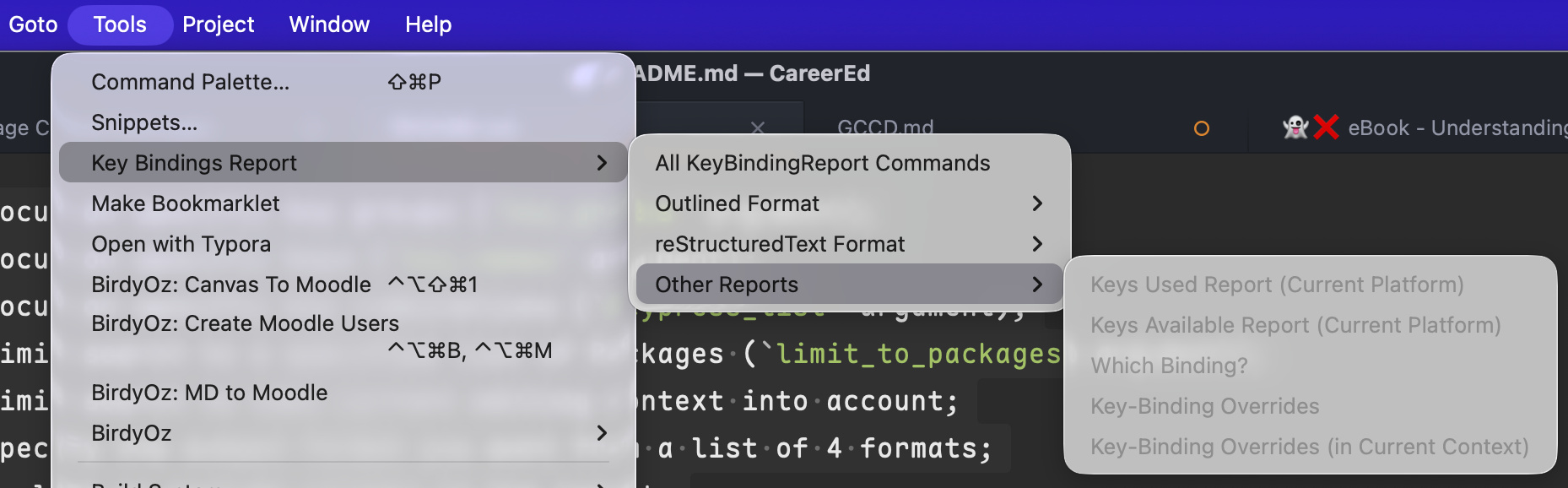
Examples:
So a necessary ingredient will be to document its API well, over and above documenting the commands that ship with it. Thoughts?
Thoughts? This is a great contribution to domain knowledge. But it is an example of another complex set of documents to be learned by the user.
My own outlier experiments are to take such archives as knowledge bases and then instruct AI Agent Claude to study and create UI operations to autonomously fulfil a task. A custom build. It is thus a reference manual for AI.
I have even conceived a protocol for this purpose. This is not limited to Subl Text but any complex UI such as Blender for example. You have produced the Subl driver’s manual as a reference for my experiments (from time to time). Now the proof of the pudding … to follow but much later. Which takes me back to old posts “klattu barada nikto”. A bit like the metaphor of the Rosetta Stone for translating bindings to UI actions. … using natural language. I often use metaphors to bridge ideas.
It’s 5 commands, all very simple except 1. The “40 commands” was 40 things you can select from the Command Palette, but 36 of them call 1 command with different arguments.